
For heavy carbon buildup, baked-on grease, or a household with young children and pets, book an eco-friendly professional oven clean rather than risk fumes and caustic chemicals at home. Non-caustic, low-odour methods now match traditional results without the health trade-offs. You can book this service online with upfront pricing and vetted technicians, so booking one takes minutes.
TL;DR:
- Eco oven cleaning avoids caustic fumes and chemicals, making it safer for homes with children and pets while delivering comparable results through patience-based methods.
- Professional services typically cover multiple appliances, including ovens, hobs, extractor fans, microwaves, and barbecues, with costs varying based on buildup severity and appliance size.
- Heavy carbon buildup requires longer contact time with eco-friendly products, and DIY methods like bicarbonate paste may struggle with tough deposits without repeated applications.
- Booking should include upfront fixed pricing, background-checked technicians, and use of biodegradable products, with extra care taken to avoid contact with electrical parts.
- Customer reviews highlight the importance of reliable scheduling, clear pricing, and effective cleaning of high-impact surfaces, with eco methods especially appreciated for their low odour and safety.
Table of Contents
- What does an eco oven clean actually cover?
- Is a professional eco clean worth it over DIY?
- How does eco oven cleaning actually work?
- What happens when a technician visits for an eco oven clean?
- How much does eco oven cleaning cost and how do you book it?
- What proof points should you look for in an eco oven cleaner?
- Do eco cleaners follow any recognised standards?
- What do customers actually say about eco oven cleaning results?
- A personal note on choosing the eco route
- Book an eco oven clean with Cleanny
- Sources
- FAQ
What does an eco oven clean actually cover?
An eco oven clean typically covers far more than the main cavity. Most professional bookings include the oven itself, but you can usually add hobs, extractor fans, microwaves, and even outdoor barbecues to the same visit.
Here's what a typical service covers:
- Single and double ovens, including the interior cavity and door glass
- Range cookers and AGAs, though these often need a longer slot due to size and construction
- Gas and electric hobs, including burner caps and control knobs
- Extractor fan filters and casings
- Microwaves, inside and out
- BBQs, particularly grease trays and grill plates
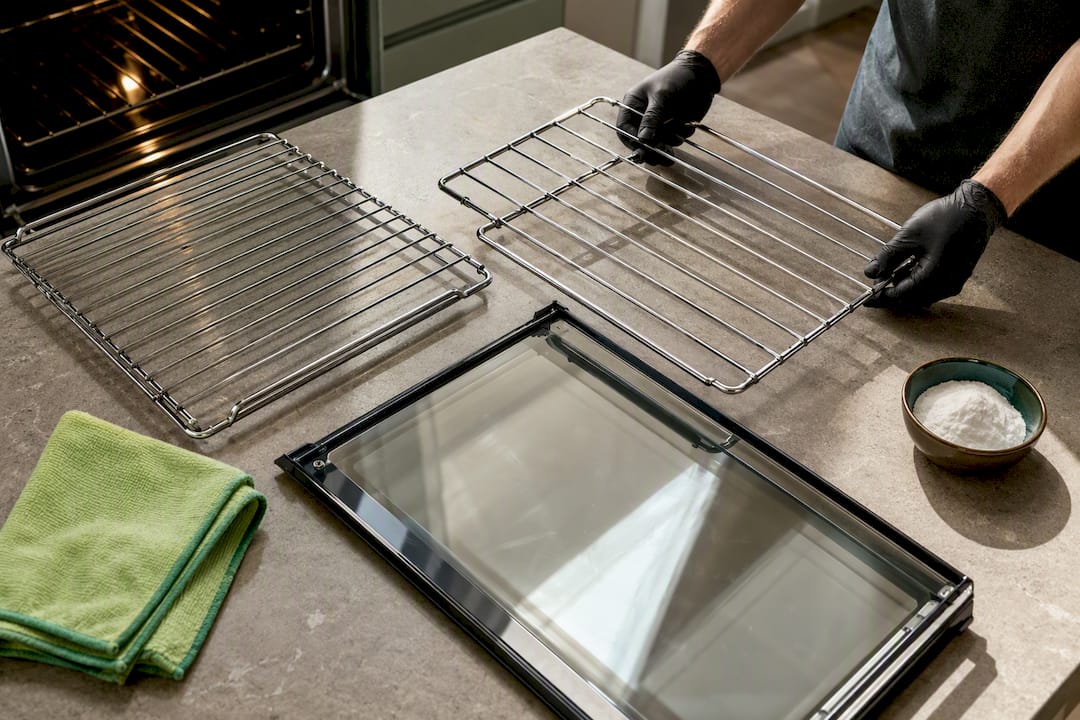
Removable parts, shelves, racks, trays, door glass, and fan covers get taken out and soaked separately, which is where most of the visible transformation happens. Technicians generally avoid heating elements and wiring altogether, since applying cleaning products to electrics risks permanent damage. AGAs and vintage appliances need extra care because parts can be older, harder to source, or simply not designed to come apart the way a modern oven does. Self-cleaning ovens present their own quirk: the pyrolytic function often means less carbon to shift, but the door seals and hidden runners still need manual attention.
Is a professional eco clean worth it over DIY?
For light maintenance, a quick wipe with a cloth and an eco spray handles most jobs. For genuinely stubborn burns, thick carbon on oven walls, or grease that's been baking on for months, a professional visit tends to save far more time and hassle than it costs.
The case for calling someone in comes down to three things:
- Time saved. Heavy carbon can take hours of scrubbing to shift with a paste, whereas a trained technician with the right tools clears it in a fraction of that.
- Safety. Avoiding caustic soda and strong fumes matters more in homes with children, pets, or anyone with respiratory sensitivities.
- Appliance care. Trained disassembly protects seals, fan blades, and heating elements from accidental damage, which is easy to cause when you're guessing which panel comes off safely.
DIY still makes sense for glass, racks, and general upkeep between deeper cleans.
Pro Tip: If you're only maintaining a fairly clean oven, do it monthly with a light eco spray. Once carbon builds up over several months, DIY effort rises sharply while the results get worse, which is exactly the point to book a professional instead.
How does eco oven cleaning actually work?
Eco cleaning relies on a different mechanism to caustic chemicals: patience rather than raw chemical force. Contact time is the real performance lever. Where a caustic dip works fast by burning through grease, a non-caustic formula needs to sit on the surface and slowly loosen it. Rush the contact time and the result disappoints; give it long enough and it can match traditional cleaning without the fumes.
Several product types show up in professional and DIY use:
- Biodegradable surfactants, which lift grease without the corrosive punch of caustic soda
- Citrus-based solvents, effective on lighter grease and pleasant to work with indoors
- Pumice-containing gels, which cling to vertical surfaces and cut through baked-on stains
Tableau's UK-made eco oven cleaner is a useful example: the manufacturer notes it works in around five minutes for light maintenance, but heavier carbon needs repeat applications. Ecozone's non-caustic gel is marketed as odourless and performs particularly well on glass and trays, though it takes more effort on thick deposits. Ecover's oven and hob cleaner uses biodegradable ingredients, and the brand's own guidance is to test a small area first and never spray it onto a hot surface.
The best-tested DIY route is a bicarbonate of soda paste left on the interior for around 12 hours, followed by a vinegar spritz to foam and lift the residue. It's genuinely effective for routine grease, but comparative tests show it struggles with the heaviest baked-on carbon without several repeat attempts.
Three safety rules matter whichever method you choose: never apply any cleaner directly to a heating element, never mix bleach with an acidic cleaner, and think twice before running a self-clean pyrolytic cycle if you want to avoid strong fumes in the house.
What happens when a technician visits for an eco oven clean?
A typical visit follows a fairly consistent sequence, whether it's a single oven or a full range cooker.
- Inspection and confirmation. The technician checks the appliance against the quote, confirming a fixed price or agreeing any adjustment on the spot.
- Disassembly. Racks, trays, and where safe, door glass and fan covers, come out for separate treatment.
- Application. Eco cleaning product goes onto the interior and removable parts, left to work for the necessary contact time.
- Soak and clean. Parts soak in a dip tank or tray while the technician works on the cavity by hand.
- Reassembly and final check. Everything goes back together, surfaces get wiped down, and a final visual check confirms the job's finished.
A single oven usually takes about an hour to an hour and a half; a range cooker or AGA can take significantly longer due to the extra surface area and parts. Technicians handle wastewater and disposal themselves rather than leaving residue for you to deal with, and some products are specifically chosen for safer disposal where that matters. On your end, clear the surrounding worktop and keep pets out of the kitchen while cleaning solution is in use.
Pro Tip: Open a window or two during the visit, even with low-odour products. It speeds up drying time and clears any residual smell faster once the technician's finished.
How much does eco oven cleaning cost and how do you book it?
Pricing depends mainly on the appliance type, how much buildup there is, and whether you're adding extras like a hob or extractor to the same visit. A single oven costs less than a range cooker or AGA, and genuinely heavy carbon that needs multiple passes will push the price up compared with routine maintenance.
A fair quote should spell out:
- Removal, soaking, and reassembly of all removable parts
- Disposal of cleaning residue and wastewater
- Realistic time on site
- Public liability insurance
- Any re-clean guarantee if you're not satisfied first time
The easiest way to get an accurate quote is to send a couple of photos of the interior and note the appliance make and model when you book. Online booking platforms make this comparison far quicker than phoning round for estimates, since you can see fixed pricing before committing. Be wary of unusually cheap one-off prices, high-pressure upselling once the technician's in your kitchen, or anyone offering to use a caustic dip tank in your home rather than off-site, since that's exactly the fume risk eco cleaning is meant to avoid.
What proof points should you look for in an eco oven cleaner?
Trust signals matter more than marketing copy when you're letting someone into your kitchen. A good eco oven cleaning service covers the basics that genuinely reduce risk for the customer:
- Online booking with upfront pricing shown before you confirm
- Background-checked technicians
- Eco-friendly cleaning products used as standard, not as a paid add-on
- A re-clean guarantee if the result isn't right
- Coverage across Greater London, Reading, Oxford, and Cambridge
Before booking any oven cleaning service, ask three questions: is the technician insured, which specific products will be used on your appliance, and does the quote include door glass and fan cover disassembly or is that charged separately? Those three answers tell you more about the quality of a service than a five-star badge on a website ever will.
Do eco cleaners follow any recognised standards?
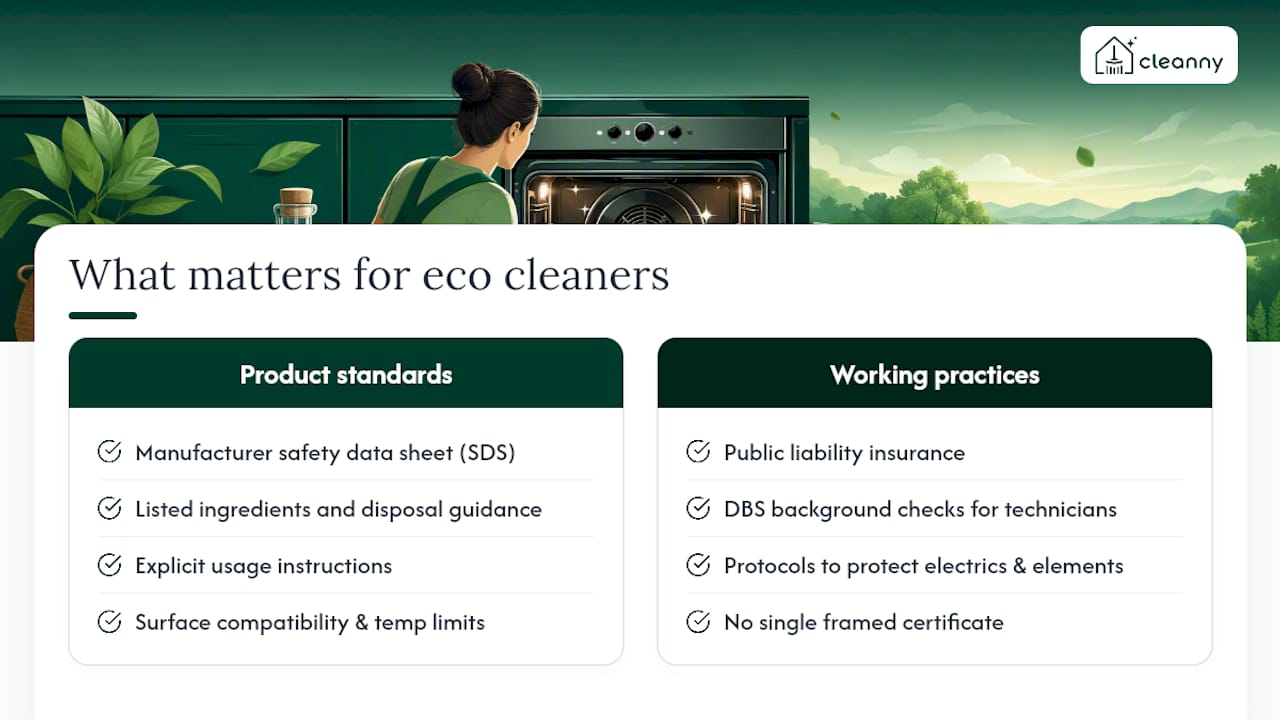
There's no single UK-wide certification scheme dedicated purely to "eco oven cleaning," which catches some homeowners out when they go looking for one. What genuinely exists, and matters more in practice, are the standards behind the products and the safe-working practices technicians follow.
Manufacturer safety data sheets are the real benchmark. A biodegradable product should list its ingredients and disposal guidance clearly, and reputable eco brands provide explicit usage instructions, including surface compatibility and temperature limits. Ask a provider whether they can share the safety data sheet for the product going into your kitchen. If they can't produce one, that's a fair reason to look elsewhere.
On the working-practices side, the standards that matter are practical rather than decorative: public liability insurance, DBS background checks on technicians, and clear protocols for keeping cleaning agents away from electrics and heating elements. None of these come with a certificate you can frame on the wall, but together they do more to protect your appliance and your family than a logo would. For interior surfaces beyond the oven itself, such as cabinet doors that come into contact with grease and steam, the same compatibility caution applies. General guidance on cleaning interior doors safely is a useful cross-check before using any new product near painted or veneered surfaces.
Biodegradability claims are worth a second look too. A product marketed as "eco" should break down without leaving persistent residues in wastewater, which is part of why some professional cleaners deliberately choose formulas noted as safe for septic systems.
What do customers actually say about eco oven cleaning results?
Reviews for eco oven cleaning services tend to cluster around two themes: relief at the smell (or lack of it) and surprise at how clean glass and racks come up compared with a DIY attempt. Customers who've previously tried caustic oven cleaner at home often mention the difference in how the kitchen feels afterwards, no lingering chemical smell, no need to air the house out for hours.
Product-level feedback backs this up. Reviewers of Ecozone's non-caustic gel frequently highlight strong results on door glass and trays specifically, while noting that the very heaviest carbon buildup still takes extra effort or a repeat pass. That pattern lines up with what professional technicians report too: eco methods excel on the visible, high-impact surfaces first, with the toughest cavity carbon needing the longest contact time or a second visit.
For a booked service, the recurring praise points aren't really about the cleaning chemistry at all. They're about the basics: turning up when promised, quoting a fair price upfront, and leaving the kitchen usable straight away rather than needing a day to air out. That's a low bar in theory, and yet it's exactly where a lot of one-off cleaners fall short, which is why upfront pricing and a re-clean guarantee carry real weight when you're choosing who to book.
A personal note on choosing the eco route
Eco methods are the right default for most family homes, but they demand patience most people underestimate. A twelve-hour paste isn't a quick fix, and neither is a gentle gel on a badly neglected oven.
Where buildup is heavy, or where you're worried about damaging seals and fans by guessing, bring in a professional rather than experimenting further. Before you book, ask for the product's safety data sheet and a clear, itemised price. A provider confident in their methods will hand both over without hesitation.
— CLEANNY
Book an eco oven clean with Cleanny
A reputable eco oven cleaning service gives you a fixed, upfront price before you commit, so there's no on-the-day surprise when the technician arrives, unlike the vague "from" quotes some cleaners lead with. Technicians are background-checked, use eco-friendly products as standard, and the job comes with a re-clean guarantee if you're not happy with the result.
Booking takes a few minutes online. Have a couple of photos of the oven interior ready, along with the make and model if you know it, so the quote reflects the actual job rather than a generic estimate. Once booked, you'll get a confirmed time slot and a technician who knows exactly what's included before they arrive. Browse the full range of cleaning services or head straight to oven cleaning to check availability in London, Reading, Oxford, or Cambridge. If you're due a wider spring clean at the same time, it's worth adding a deep clean to the same booking. Ready to sort the oven properly? Book your clean online now.
Sources
- Eco Oven Cleaner 500ml - Home Care Products from Tableau
- Oven & Hob Cleaner | Eco Friendly Cleaning | Ecover
- Eco-friendly oven cleaner the family guide | The Zoo Family
FAQ
How much does professional oven cleaning cost in the UK?
Pricing varies by appliance type, buildup severity, and any extras added to the visit, so it's best treated as a quote rather than a fixed list price. Cleanny's current oven cleaning prices are available directly on its services page once you enter your details.
Do baking soda and vinegar really clean an oven?
Yes, for routine grease and light to moderate buildup, a bicarbonate of soda paste left for around 12 hours followed by a vinegar spritz works well and costs almost nothing. It's less effective against very heavy, months-old carbon, where a professional eco clean or repeat applications tend to give better results.
How do I remove brown stains from a glass oven door?
Non-caustic gels containing pumice, such as Ecozone's oven cleaning gel, tend to perform particularly well on door glass compared with the oven cavity itself. Leave the product on for the manufacturer's recommended time before wiping, and avoid abrasive scrubbing that can scratch the glass.
What's the easiest way to clean an oven naturally?
The baking soda and vinegar method is the easiest and best-tested natural approach for everyday grease, mainly because it needs no special equipment. For heavier, baked-on carbon, a ready-made non-caustic gel or a booked professional clean will usually get better results with far less scrubbing effort.