
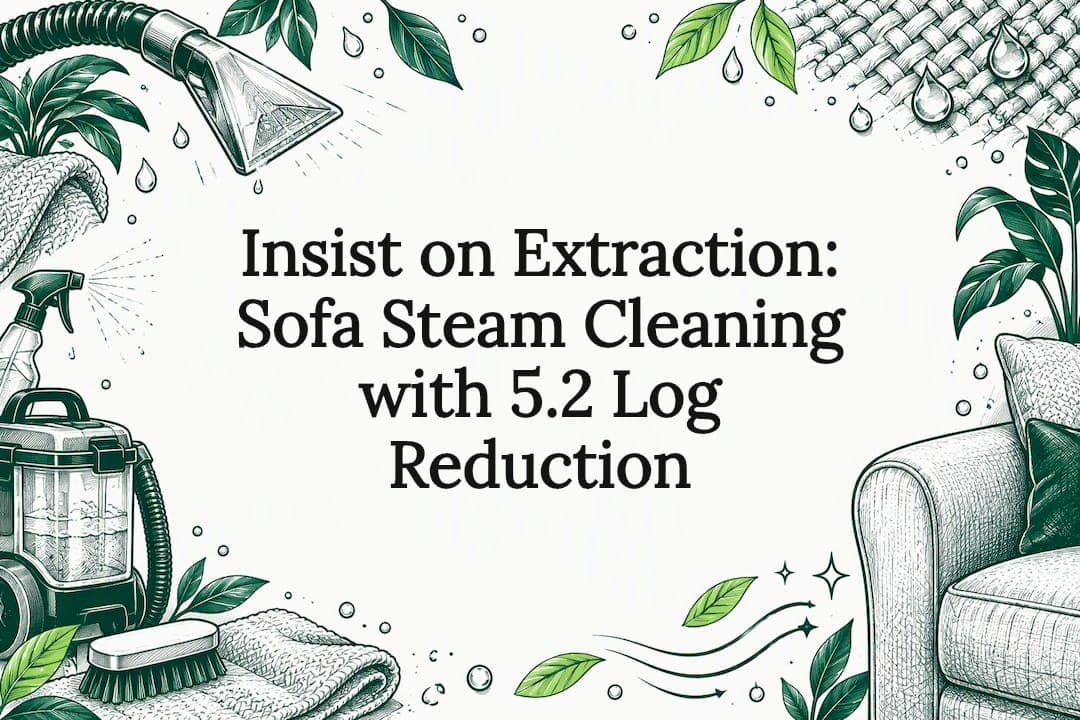
For deep cleaning and sanitising most sofas, hire a professional hot water extraction service, often marketed as steam cleaning. Done properly, it sanitises fabric, lifts embedded grime and removes allergens that vacuuming cannot reach. Before booking, check the sofa's care label and ask the cleaner about extraction power and drying time. Professional hot water extraction cleaning services are available with upfront pricing.
TL;DR:
- Proper hot water extraction can achieve a viral reduction of at least 5.2 log10 within 15 seconds, outperforming many chemical antimicrobials in speed and effectiveness.
- Ensuring the technician tests fabric care labels, checks colourfastness, uses sufficient extraction power, and follows industry standards is crucial to avoid sofa damage.
- Drying time depends heavily on extraction strength and air circulation, with most sofas becoming touch-dry in a few hours and fully drying overnight.
- A typical professional sofa cleaning takes between 45 minutes and two hours, including preparation, spot treatment, and inspection, but not full drying time.
- Booking advice includes asking about equipment, testing, guarantees, and proper fabric handling, with red flags being lack of insurance, untested methods, or vague drying estimates.
Table of Contents
- Steam cleaning versus a handheld steamer: what's the real difference
- What the evidence says about sanitising power
- What actually happens during a professional visit
- Questions to ask and warning signs to watch for
- What it costs and how often you should book
- How long a professional visit actually takes
- Extras that often come bundled with a sofa clean
- What kind of guarantee you should expect
- Getting your sofa and room ready before the technician arrives
- Why the steam cleaning conversation misses the point
- Cleanny: how our upholstery steam-cleaning service meets these standards
- Sources
- FAQ
Steam cleaning versus a handheld steamer: what's the real difference
Professional "steam cleaning" is almost never just steam. It's hot water extraction: a machine sprays hot water and a small amount of detergent into the fabric, agitates it to loosen dirt, then immediately vacuums the liquid back out along with the dissolved soil. The extraction step is what actually removes contamination rather than just heating it in place.
A handheld consumer steamer works differently. It produces hot vapour that can loosen surface dirt and kill some surface bacteria, but it has no extraction stage, so moisture and loosened soil stay in the fabric. Left there, they can lead to mildew, watermarks or set-in stains rather than a genuinely clean sofa.
The fabric itself also matters:
- Delicate weaves and some synthetic blends can shrink, discolour or warp under high heat without proper testing first.
- Leather and suede need entirely different treatment and should never be steamed with water-based extraction.
- Fabrics coded "S" on their care label (solvent only) can be damaged by water-based cleaning altogether.
This is why professionals test a hidden patch before starting, rather than applying one method to every sofa.
What the evidence says about sanitising power
The case for hot water extraction isn't just anecdotal. A peer-reviewed study in Applied and Environmental Microbiology found that a 15-second steam treatment produced a log10 reduction of at least 5.2 against human norovirus surrogates on fabric, while some EPA-registered chemical antimicrobials needed far longer contact times to achieve comparable results and risked weakening fibres with repeated use. For a family sofa that sees spills, pets and daily use, that's a meaningful difference: a short, high-heat extraction pass can outperform a chemical spray that has to sit for half an hour and still be reapplied over time.
Steam treatment achieved at least a 5.2 log10 reduction of viral surrogates in 15 seconds, while chemical antimicrobials required considerably longer contact times to reach similar levels.
Professional bodies back this up with formal standards rather than marketing claims. The IICRC S300 standard sets out the equipment specifications, testing procedures and fabric-code checks that professional technicians are expected to follow, while the NCCA code of practice requires trained technicians to test colourfastness and follow safe working methods before they touch a client's furniture. Extraction power and contact time both matter here: weak suction leaves moisture and soil behind, and too little contact time undermines the sanitising effect the heat is meant to deliver.
What actually happens during a professional visit
A technician doesn't just wheel in a machine and start spraying. The process generally follows a set order, and knowing it helps you judge whether a quote is thorough or corner-cutting.
- Check the fabric code and any fire-safety label, usually found under cushions or on the frame, as required for upholstered furniture sold in the UK under the Furniture and Furnishings (Fire) (Safety) Regulations 1988.
- Run a colourfastness test on a hidden patch and flag any removable covers that might need separate handling.
- Vacuum the whole sofa thoroughly to remove loose debris before any liquid touches the fabric.
- Apply targeted spotting to stains or heavily soiled areas with an appropriate pre-treatment.
- Carry out hot water extraction across the full sofa using a detergent suited to the fabric type.
- Use extraction strength and air movers to pull out as much moisture as possible before leaving.
- Do a final inspection, flag anything unresolved, and give drying advice.
Drying time depends heavily on extraction strength rather than just ambient temperature. A well-run service, with strong suction and air circulation, typically leaves a sofa touch-dry within a few hours, with full drying overnight in most rooms.
Pro Tip: Open a window or run a fan near the sofa for the first few hours after cleaning to help the fabric dry evenly and avoid a musty smell.
Questions to ask and warning signs to watch for
Not every cleaner who advertises "steam cleaning" is running proper hot water extraction, so a short conversation before booking tells you a lot.
- Ask what equipment they use and whether it performs true extraction rather than vapour-only steaming.
- Ask whether they test for colourfastness and check fire-safety labels before starting.
- Ask about insurance cover and what happens if something goes wrong with your sofa.
- Ask for a realistic drying time estimate rather than a vague "a few hours".
- Ask whether they offer any guarantee if you're unhappy with the result.
Red flags include a cleaner who can't describe their equipment, who pushes chemical-only treatment as a substitute for extraction, who has no insurance, or who won't test the fabric first. Trust signals run the other way: adherence to IICRC or NCCA guidance, a technician who actually turns up to do the job rather than subcontracting it unannounced, clear before-and-after expectations, and pricing you can see before you commit.
What it costs and how often you should book
Price depends mainly on sofa size, fabric type, soiling level and whether stain protection or odour treatment is added on top of a standard clean. A small two-seater in good condition costs less to treat than a large corner sofa with ground-in grime or pet odour, since the latter needs more product, more passes and more drying management.
As a general rule:
- Clean upholstery every 12 to 18 months if the household has no pets, allergies or small children.
- Clean more often, roughly every 6 to 12 months, where there are pets, young children or someone with allergies.
- Book promptly after a major spill, a bodily-fluid incident or a pet accident rather than waiting for a routine slot, since set-in stains and odours are harder to shift the longer they sit.
- Expect enzymatic treatment and extra odour remediation to add to the cost when urine or other organic stains are involved, since these need a different chemistry than a standard detergent pass.
How long a professional visit actually takes
A typical sofa steam cleaning appointment runs from about 45 minutes to two hours for a single three-seater, though the figure moves with sofa size, fabric and soil level. That window already includes the preparatory steps, not just the extraction pass itself.
Preparation, checking labels, testing fabric and vacuuming, usually takes 10 to 15 minutes before any liquid is applied. The extraction stage itself, including spot treatment for stains, is the longest part and can take anywhere from 20 minutes on a lightly soiled two-seater to well over an hour on a large, heavily used corner sofa. A final inspection and handover advice add another few minutes.
Drying isn't usually counted inside the appointment time because the technician doesn't wait on site for the sofa to dry completely. Instead, they leave it in a touch-dry state using strong extraction and, where needed, an air mover, with full drying happening over the following hours while you get on with your day. A well-run job leaves the sofa usable again the same evening in most cases, rather than out of action for days.

If you're booking alongside another service, such as a carpet clean in the same room, factor in the combined time rather than assuming they'll run in parallel, since most technicians work through one surface at a time to manage moisture properly.
Extras that often come bundled with a sofa clean
Standard hot water extraction covers cleaning and sanitising, but most professional cleaners offer a few add-ons worth considering at the same visit.
Stain protection is the most common upsell, applied after the sofa has dried or near the end of the service, and it's designed to make future spills easier to blot up before they soak in. Deodorising treatment is another frequent addition, usually aimed at pet odour, smoke residue or general mustiness that a standard detergent pass doesn't fully clear. For households dealing with urine or other organic stains, an enzymatic treatment is often offered separately from the standard clean, since it works through a different mechanism, breaking down the organic matter rather than just lifting surface soil.
Some cleaners also bundle upholstery work with a wider job, such as a carpet clean in the same room or a broader deep home clean, which can be more efficient than booking separate visits if you're tackling a whole room rather than just the sofa. It's worth asking upfront which of these are included in a quoted price and which are charged as extras, since "sofa cleaning" without qualification can mean very different scopes of work between providers.

What kind of guarantee you should expect
A professional cleaner should stand behind their work in some form, though the exact shape of that guarantee varies by provider. The most common version is a satisfaction guarantee: if a stain hasn't lifted or an area looks patchy once the sofa has fully dried, the cleaner returns to re-treat it at no extra charge rather than asking you to pay for a second visit.
Fewer cleaners offer anything beyond that, such as compensation for fabric damage, and this is worth asking about directly rather than assuming it's included. A cleaner who can't explain what happens if something goes wrong, whether that's a colour change, shrinkage or a lingering odour, is a weaker bet than one with a clear, stated policy. Insurance cover is a separate but related question: ask whether the technician or company carries liability cover for accidental damage, since a guarantee on cleaning quality doesn't always extend to covering a damaged frame or torn fabric.
Treat the guarantee as part of the quote, not an afterthought. A slightly higher price from a cleaner with a clear re-clean policy and insurance cover is often the better value than a cheaper quote with no stated recourse if the job falls short.
Getting your sofa and room ready before the technician arrives
A few minutes of preparation makes the visit faster and the result better. Clear the sofa of cushions, throws, toys and anything stored underneath or behind it, since the technician needs full access to the fabric and frame. Vacuum loose crumbs and pet hair yourself beforehand if you can, though most professionals will do this as their first step anyway.
Move small furniture, rugs or lamps that sit close to the sofa so there's room to work and for air movers to circulate afterwards. If there are removable cushion covers, check whether they're machine washable separately or need the same extraction treatment, and mention this when booking rather than on the day. Point out any specific stains, their likely cause, and roughly when they happened, since this helps the technician choose the right pre-treatment rather than guessing.
Finally, plan around the drying window. Avoid scheduling the visit right before guests arrive or before you need to use the sofa for sitting or sleeping, since it will need several hours, and ideally an evening, to dry fully even with good extraction and air movement.
Why the steam cleaning conversation misses the point
Most advice on this topic focuses on the wrong question. People ask whether steam cleaning "works", when the more useful question is whether the person doing it is actually using extraction equipment and testing the fabric first. The technology isn't the variable that matters most: the technician's process is.
The conventional wisdom also understates how much damage a rushed or untested job can do. A cleaner who skips the colourfastness check or ignores a fire-safety label isn't just risking a slightly worse result, they're risking a stained, shrunk or discoloured sofa that costs far more to fix than the original clean. Reading a fabric code and running a ten-minute test isn't an optional extra: it's the difference between a professional job and a gamble.
If there's one thing worth prioritising above cost or speed, it's asking direct questions about equipment, testing and guarantees before anyone touches your sofa. A slightly more expensive quote from someone who can answer those clearly beats a cheap one from someone who can't.
— CLEANNY
Cleanny: how our upholstery steam-cleaning service meets these standards
Booking a sofa clean shouldn't mean guessing at a price or hoping the technician who turns up knows what they're doing. Cleanny's upholstery cleaning service is booked online with a price shown upfront, so you know the cost before you commit rather than waiting for a quote after the visit.
This matches the best practices this guide has covered step by step:
- Technicians are background-checked before carrying out the hot water extraction.
- Eco-friendly cleaning products can be used as standard, with no pressure to accept chemical-only shortcuts.
- A re-clean guarantee is often offered if an area needs revisiting once the sofa has dried.
- Booking can be available online, including evenings and weekends.
Have your sofa's fabric type and any specific stains ready when you book, since this helps the technician prepare. You can see the full range of related work, including deep cleaning for a whole-room refresh, or go straight to book a clean online and get a fixed price before you confirm.
Sources
- IICRC S300 Consolidated Draft Standard (public review)
- Efficacy of three EPA-registered antimicrobials and steam against two human norovirus surrogates on nylon carpets with two backing types | Applied and Environmental Microbiology
- Furniture and Furnishings (Fire) (Safety) Regulations 1988 — Schedule 3
- NCCA code of practice
FAQ
Does steam cleaning a couch actually work?
Yes, when it means professional hot water extraction rather than a handheld vapour steamer. A peer-reviewed study found a 15-second steam treatment achieved at least a 5.2 log10 reduction of viral surrogates on fabric, showing genuine sanitising power when extraction is used correctly.
Can I steam clean a sofa myself?
You can use a handheld steamer for light surface refreshing, but it lacks the extraction stage that removes loosened soil and moisture from the fabric. For deep sanitising or set-in stains, a professional hot water extraction service following IICRC S300 testing procedures gives a more reliable result.
What is the best way to clean a fabric sofa?
The best approach starts with checking the fabric code and fire-safety label, then testing colourfastness on a hidden patch before applying any liquid. For most fabric sofas, professional hot water extraction, which sprays, agitates and immediately vacuums out the dirty water, outperform surface steaming or spot cleaning alone.
Can fabric couches be steam cleaned?
Most fabric couches can be safely cleaned with hot water extraction, provided the technician checks the care label first, since codes like W, S, WS or X indicate which methods are safe. Fabrics coded "S" require solvent-based cleaning rather than water, which is why testing before treatment matters.
How often should I have my sofa professionally cleaned?
Most households do well with a professional clean every 12 to 18 months, or every 6 to 12 months where there are pets, young children or allergy sufferers. Spills, pet accidents or other bodily-fluid events are worth booking for promptly rather than waiting for the next routine clean.